Definition
What Is Core Web Vitals?
Core Web Vitals are Google's three field metrics for page experience: loading (LCP), responsiveness (INP), and visual stability (CLS). They are measured on…
Core Web Vitals are Google's three field metrics for page experience: loading (LCP), responsiveness (INP), and visual stability (CLS). They are measured on real visits, not in a lab, and they feed into ranking as a minor signal.
The three metrics each capture a different way a page can feel broken. Largest Contentful Paint measures how long until the main content appears — good is under 2.5 seconds. Interaction to Next Paint measures how quickly the page responds to taps and clicks — good is under 200 milliseconds. Cumulative Layout Shift measures how much the layout jumps while loading — good is under 0.1.
What counts for search is field data, not your local Lighthouse score. Google evaluates the 75th percentile of real Chrome users over a rolling 28-day window, which is why a page that scores 98 on your laptop can still fail: your laptop is not a mid-range Android on a bad connection. Lab tools are for diagnosis; the Search Console report and the CrUX dataset are the scoreboard.
Keep the ranking weight in proportion. Page experience is a tiebreaker, not a substitute for relevance — a slow page that answers the query still beats a fast page that doesn't. The business case is usually stronger than the SEO case anyway: the same fixes that pass the thresholds measurably reduce bounce and lift conversion rate, especially on mobile.
The practical play is to fix causes rather than chase scores. Most LCP failures trace to an unoptimised hero image or render-blocking resources; most CLS to images and ad slots without reserved dimensions and to fonts that swap late; most INP to heavy JavaScript on the main thread. Fix them at the template level and every page of that type improves at once.
Examples
- A hero image served as an unsized 1.8 MB PNG — the single most common cause of a failing LCP.
- An ad slot or cookie banner injected after render, pushing the article down as the reader starts to read: a textbook CLS failure.
- A product page passing in the lab and failing in the field, because real traffic is 70% mobile on slower networks than the test.
Common questions
Are Core Web Vitals a ranking factor?
Yes, as part of the page experience signals — but a light one. They mostly matter as a tiebreaker between pages of comparable relevance, and as a conversion lever in their own right.
What replaced First Input Delay?
Interaction to Next Paint (INP) became a Core Web Vital in March 2024, replacing FID. INP measures responsiveness across the whole visit rather than just the first interaction, so it's a harder and more honest test.
Why does my page pass in PageSpeed Insights but fail in Search Console?
PageSpeed's lab test simulates one device; Search Console reports field data from real Chrome users at the 75th percentile over 28 days. Field data is what counts, and it lags fixes by up to four weeks.
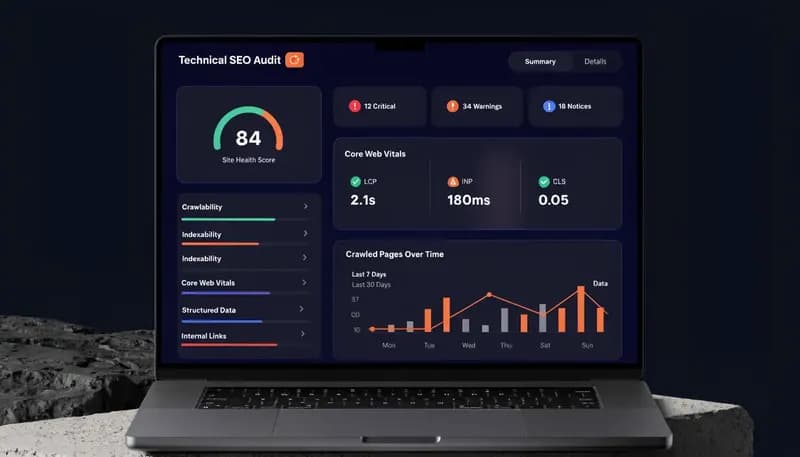
Allable's Technical SEO Audit catches the failures before Google does
Allable crawls your site, flags the pages failing LCP, INP, and CLS, and tells you which template-level fix will clear the most URLs at once — ordered by impact, not by severity label.
Also known as
Do it automatically
Technical SEO Audit Tool
Put Core Web Vitals to work — see how Allable handles it for you.
Your competitors are already using AllAble. Are you?
The marketers pulling ahead aren't working harder. They're just working with one tool that does everything — that tool is AllAble. Try it yourself!